Scales and Arpeggios
This part is dedicated to aspects of scale practice and usage in improvisation.
This part is dedicated to aspects of scale practice and usage in improvisation.
The adapted exercise with random chord changes (cf. end of section) is an exercise for beginners that will help them to:
The major scale and its relative natural minor scale are a minor third apart and share the same notes. A typical scale practice exercise uses a G major or an E natural minor scale in one position up to the octave, ascending and descending.
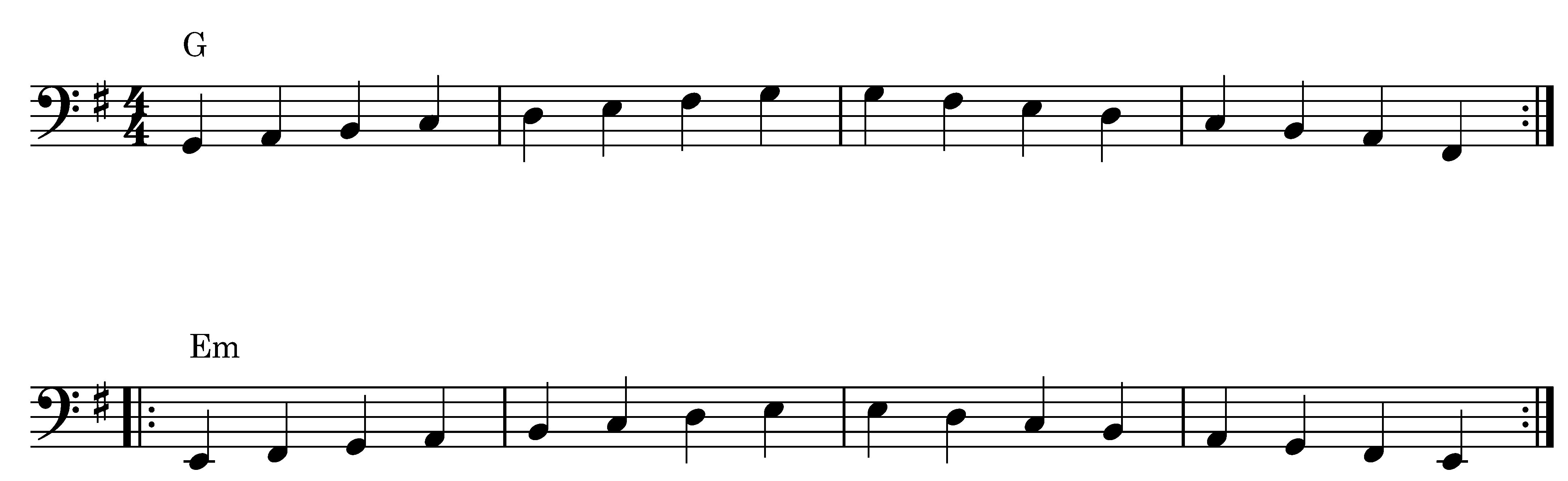
In this situation, although the repeated G in bar 3 is quite common, it is not a very musical way to practice scales over a backing track because chord tones in the second half will not fall on strong beats. In the last bar, the F# is played before going back to G, which smooths out the line. For the E minor scale, the final E is doubled, which breaks the flow.
Furthermore, although the same notes are to be played in the two scales, no connection is revealed to the student. The following exercise is an adapted version where the flow is maintained throughout and the two shortcomings of the base exercise are addressed:

Here is a seven-bar circular version of the same exercise. The harmony starts to blur, with the lowest note influencing the perception of minor/major. This exercise could also start on E:

The accompaniment track with guitar and piano either plays a G chord at a slow tempo (80 bpm):
or an Em7(add 11) voicing:
This is the randomized exercise. Every two bars, either an Em7(add 11) or a G will be played on guitar and piano. The main objective for a beginner will be to use the correct fingering and aim for legato playing at a slow tempo. A more advanced student can focus attention on the sound and emotional effect produced by randomly changing chords.

Several standard jazz improvisation methods1 list the continuous scale exercise as one of the main exercises to master. It can be adapted for beginners and more advanced students. The example above only uses two chord progressions with an altered chord resolution going to a minor or major chord. The preceding ii will give away the continuation of the exercise and could be left out.
When the two progressions are randomized, the student (intermediate to advanced in this case, especially if played in thumb position) has to make minor adjustments in bar three when resolving. This helps students rely on their ears to anticipate the resolution and trains them to differentiate altered chords and their respective resolutions.
This exercise can easily be extended, and the evaluation and learning points can be gradually integrated and checked by adding more chord progressions or more difficult ones. The student can use the same exercise to train at home and during class.
E.g., Levine, M. (1995). The Jazz Theory Book. Sher Music. ↩︎
Pentatonic scales are used extensively in many different musical styles and have been widely adopted in jazz. Pentatonic scales have a strong independent sound and “it is very easy to perceive them as bitonal elements on top of the harmony” (van de Geyn, 2011, p. 8).
In an instructional video from the 1980s, John Scofield1 discusses his approach to pentatonic scales. The following table summarizes the available inside-sounding options2 according to chord type:
| Chord Type | HVG | HVG | HVG | Scofield |
|---|---|---|---|---|
| CMaj7 | A- | E- | B- | C, A-, D, Ddom penta, B- |
| C-7 | G- | C- | C-, G-, D- | |
| C-Maj7 | D- | |||
| C7(9 13) | A- | C, Cdom, Ddom, G- | ||
| C7alt | Eb- | Eb- | ||
| C7ø7 | F- | Eb- | Ab dom |
The following is an exercise I designed for intermediate-level students that helps them perform pentatonic major (and their relative minor) scales all over the neck on all four strings in different positions. It’s built around the chords of “Sunny”3, a tune with a melody based solely on minor pentatonic notes but with changing chords.
In the following version in E minor, adhering strictly to the E minor/G major pentatonic scale will create tension on certain chords, but overall strong melodic motion will result. In “The Serious Jazz Book II,” B. Finnerty4 lists similar exercises with arpeggios or different cells.
Here is the exercise with piano and bass:
Here is the exercise as I uploaded it to the MuseScore website, with advanced MIDI playback (but no chord playback):