This part is dedicated to aspects of rhythmic accuracy, groove, and performing complex rhythms. Time is most likely the key element to master for every jazz and pop musician, but it is also one of the most elusive parameters. Pianist Fred Hersch, referring to a performance, puts it this way:
“There should be ten, fifteen different kinds of time. There’s a kind of time that has an edge on it for a while and then lays back for a while. Sometimes it rolls over the bar, and sometimes it sits more on the beats. That’s what makes it interesting. you can set a metronome here and, by playing with an edge of playing behind it or right at the center, you can get all kinds of different feelings. That’s what makes it come alive. People are human, and rhythmic energy has an ebb and flow.”1
Most instrument methods or books on jazz improvisation contain specific chapters on rhythm, but very few are entirely dedicated to purely rhythmic aspects, with the exceptions of, for example, a book2 by drummer Bob Moses or a method3 by drummer Billy Martin.
A few words of caution on working with metronomes and machines appear in the following video4 by Richie Beirach on developing a better sense of time:
“Listen to great examples … check Out Speak no Evil, listen to Elvin Jones, Herbie, Freddie, Wayne, Ron Carter”
“Forget about the metronome”
“Metronomes are suicide for the Jazz musicians”
“Metronomes are good for kids because when you are practicing you are lonely and scared and it helps to feel not so lonely”
“Perfect time doesn’t help you with your jazz rhythm.”
“Is a click track great for pop music? Yeah, it keeps everybody together. Pop music can be creative, but it is not improvised; it is a whole different genre. I believe in the click track too.”
Berliner, P.F. (1994). Thinking in Jazz: The Infinite Art of Improvisation. Chicago Studies in Ethnomusicology. ↩︎
Moses, B. (1984). Drum Wisdom. Modern Drummer Publications (republished in 2022 as a Kindle edition). ↩︎
Martin, B. (2006). Riddim: Claves of African Origin (D. Thress, Ed.). Alfred Music. ↩︎
Beirach, R. (2021). Richie Beirach on developing a better sense of time. https://vimeo.com/539936515/5c86756b12. (These wise words might serve as a natural antidote, but it is still advisable to get your shots.) ↩︎
Subsections of Groove
Time Feel
Breaks and Drum Fills
In pop music, drum fills are often played at specific points in the cycle—for example, every 4 or 8 bars—and are often improvised. The following exercise will help you keep time during the fill. The first example uses simple in-time fills with no rests. The learning objectives in this case can be loosely defined—for example, use an easy, well-mastered exercise to play along and keep time.
Exercise 01: Fills
Note that the 3-bar groove consists of 3 different drum groove alternatives, and the 5 fills are played randomly every 4 bars. The groove is inspired by “Kissing My Love”1 by Bill Withers.
Exercise 02: 2-Beat Rests
Exercise 2 is more challenging, leaving two beats of rest in bar 4.
Exercise 03: Start With Rest During Break
Exercise 3 reverses the concept of ex. 2 and starts random breaks with two beats of rest.
Exercise 04: Full Bar of Rest
Exercise 4 stops right before beat 4 of bar 3 and leaves a full bar of rest. This exercise can now be extended to two or even three bars of rest.
Random Mix of Rests and Fills With Count-In
The next iteration would be very difficult to recreate in some DAWs, even Ableton (especially if non-metered audio files were used). It leverages the adaptive audio features by creating a mix of all preceding exercises. Now, for every cycle of four bars, the following happens at random:
one of 4 drum patterns is picked
one of 5 fills is selected
one of 5 exercises is selected
Behind the Scenes
On the technical side, the same short drum loops are used in all the preceding examples and then recombined, which multiplies the number of possibilities from simple base material. Please refer to the chapter from the main thesis for further technical details and the problems with creating perfect loops and testing all possibilities.
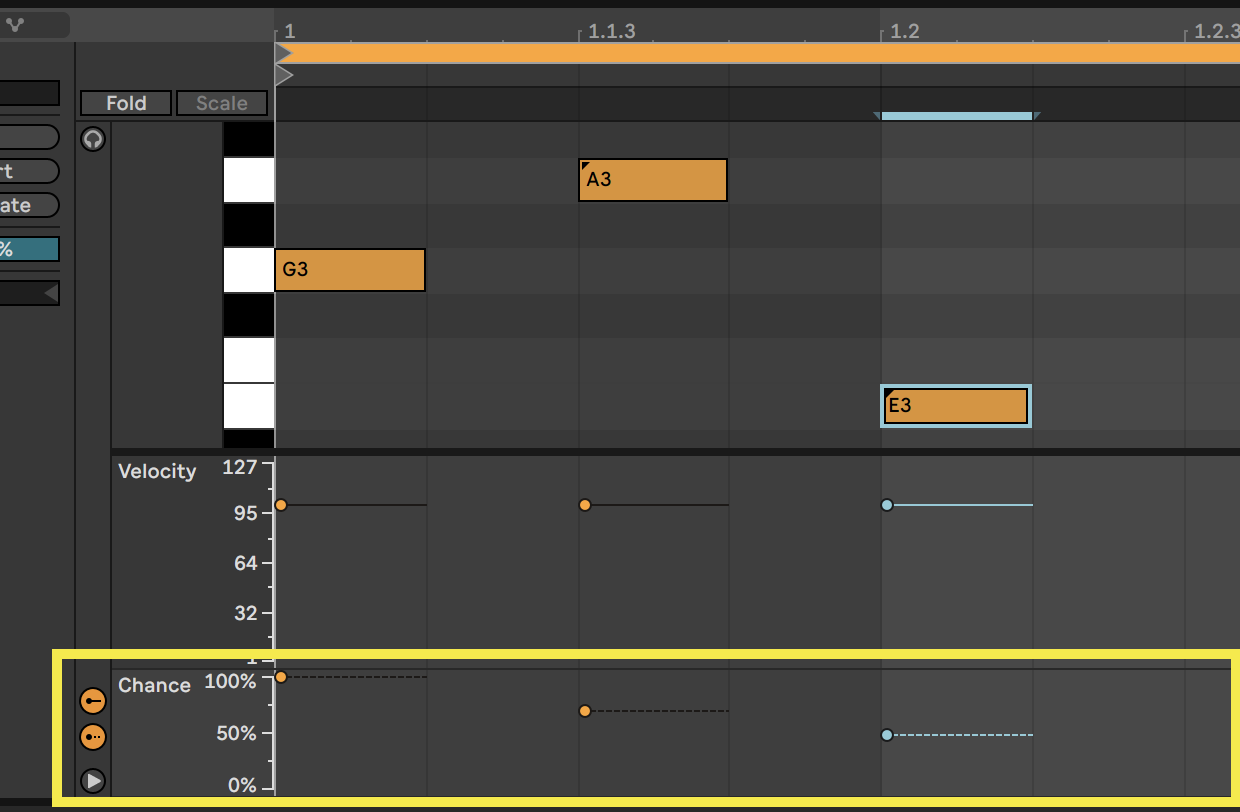
The Time Guru metronome (see methodology section) uses a random slider with a percentage setting to select the probability of drum hits being played. A gradual fade option is added to this “random mute slider”:
Many DAWs and plugins offer functions to set playback probabilities, although as a standard feature in some DAWs, this is a recent1 development.
Drum Kit Mutes
The next exercise applies this idea to a drum kit by randomly fading out certain parts of the drum kit, limited for the sake of this example to bass drum, snare, and hi-hat. Although fades happen randomly, the exercise was constructed so that there are no long blanks with every element of the kit being muted. This silence setting is one key element in finding the right difficulty level for this exercise.
The objectives can be varied—for example, as in the previous exercise, use a simple exercise and play along without losing time, or for more advanced players, increase the fade times and play more advanced improvisations or exercises.
A chance setting for notes was only introduced in Ableton Live 11 in February 2021. ↩︎
Rhythmical Displacements
Melodic Displacements
The following example uses 4 rhythmic displacements (eighth note, quarter note, and sixteenth note). These rhythmic devices are used extensively in composition1 and improvisation. This is a basic example, though only the eighth-note and quarter-note displacements might be appropriate for beginners.
Randomized Displacement With Different Exercise Options
Options a, b, c, and d are played randomly, with a 15% chance setting for option d, which can be considered the most difficult performance-wise.
Also note that:
the drum groove is 4 bars long and randomly plays 3 different variations
there are 2 possible drum fills, one with a 1-bar drum silence
the guitar part is 8 bars long with different rhythmic variations on E7#9.
This is a good example of the potential for spontaneous variation by using short, similar loops of different lengths.
Based on this simple example, many variations can be created. By muting the drums, the guitar, or both, the playback becomes a time-keeping exercise. The quantize setting can be randomized, and more advanced subdivisions become imaginable, such as transformations2 into other beat subdivisions (triplets, quintuplets, septuplets) and their respective displacements.
Cf. rhythmical sangatis, p. 61, in Reina, R. (2017). Applying Karnatic Rhythmical Techniques to Western Music. Routledge. ↩︎
Swing Ratios
Swing ratios are commonly used in music notation programs to emulate swing feel. Expressed as a percentage, the ratio refers1 to consecutive eighth (or sixteenth) notes performed as long-short patterns. Microtiming2 studies have shown that these ratios vary widely depending on style, tempo, musicians’ affinities, and cultural background.
In a fascinating article3 on the impact hip-hop producer J Dilla had on live drum kit performance and pedagogy, Daniel Stadnicki analyzes “how the so-called ‘Dilla-feel’ is emulated by drummers and rhythm section players through a range of informal learning strategies and extended techniques, which include practices of online teaching and learning.”
J Dilla used4 the Akai MPC music workstation, which offers sampling and sequencing capabilities. Swing ratios can be set as a percentage. In DAWs, different names are used—for example, grooves in Ableton, groove quantize presets in Cubase, or groove templates in Logic. Another way to express this swing ratio is by using tuplet notation. This approach certainly doesn’t do justice to the different shades of microtiming, but it has the merit of offering a clear approach to these types of grooves.
The cowbell from the Afro-Peruvian Festejo rhythm is an example of an original swing feel between binary and ternary time:
Festejo with cajita, quijada, congas, bongo, and cajon:
Feel the Swing
I took inspiration for the next exercise from a 16-year-old beginner student who, while working on shuffle songs, asked me why the groove of some hip-hop tunes felt5 so different from, for example, blues shuffle songs. In the next example, the drum groove over the first 2 bars is straight, which corresponds to a 50% swing ratio or no swing at all; the two notes on the hi-hat have the same length. The swing feel on the hi-hat in bars 4 and 5 equals a 66.6% swing ratio, or a perfect triplet division, with the first note taking up 2/3 of the beat division and the second 1/3. A 60% swing ratio would correspond to 3 and 2 quintuplets (bars 5 and 6). A septuplet division (5 and 3 septuplets) yields approximately a 57% swing ratio.
Guess the Ratio
When randomizing this example with two-bar fragments, different exercises are conceivable for beginner to intermediate students:
try to identify whether a change happens (a two-bar sequence might be played twice or more; 25% chance setting)
identify the ratio
play along with only quarter notes
try to emulate the feeling by adapting your bass line to the drum groove
Friberg, A., & Sundström, A. (2002). Swing Ratios and Ensemble Timing in Jazz Performance: Evidence for a Common Rhythmic Pattern. Music Perception, 19, 333–349. ↩︎
Collier, G. L., & Collier, J. L. (1996). Microrhythms in jazz: A Review of Papers. Annual Review of Jazz Studies, 8, 463–483. ↩︎
Stadnicki, D. A. (2017). Play like Jay: Pedagogies of drum kit performance after J Dilla. Journal of Popular Music Education, 1, 253–280. ↩︎