Methodology

Sources

The title of this research refers to randomness and surprise. My MA research opens by referencing an article1 on the essence of musical surprises. Musical surprises take on many forms: rhythmic, harmonic, melodic, timbral, and so on. Musical surprises are generally considered to fall under the category of perceptual surprises, characterized2 as frustrating prior expectations.

In the field of cognitive and behavioral science, research has been undertaken into the potential of surprise to stimulate learning:

“Music ranks among the greatest human pleasures. It consistently engages the reward system, and converging evidence implies it exploits predictions to do so. Both prediction confirmations and errors are essential for understanding one’s environment, and music offers many of each as it manipulates interacting patterns across multiple timescales. Learning models suggest that a balance of these outcomes 
 optimizes the reduction of uncertainty to rewarding and pleasurable effect.”3

The focus will be on these random elements and their potential to create surprises when introduced into typical jazz improvisation exercises and their impact on learning. One might view these music exercises as an elaborate form of flashcards (for an example of research on the potential of flashcards4 in increasing science vocabulary, see the reference). I also note the use of games in training musical skills. For example, rhythm exercises seem promising, as studies5 point to the importance of using games for rhythmic6 training. It is also worth noting that randomized tests are widely used in research on musical parameters such as pitch and rhythm recognition, as in pitch memory research.7

Every exercise also concludes with a short overview of:

  • the main learning objectives
  • teaching material used (mostly jazz bass and improvisation methods)
  • comments

Technical Aspects

Guidelines used for the exercise creation:

  • easy to use
  • good-sounding despite mostly using samples
  • multitrack8 enabled (mutes for different instruments)
  • short loading times
  • compatible with mobile and desktop devices
  • multiple browser support
  • concise in their scope

Here is an example of a flamenco multitrack playback (note: you should see “Channels Playing” and “CPU,” and use the playback and mute buttons):


Please wait... Loading...


Technical Details

For a detailed overview of the technical aspects of creating the exercises, please refer to the methodology section of my MA research. All the exercises were created with free tools from the field of music and audio design in computer games (cf. sections on adaptive audio and music in video games).

This methodology continues on the next pages with further sources and methods I used to compile the improvisation exercises, reference a final assignment9 on “How to Teach Improvisation,” and list different music apps.


  1. Judge, J. (2018). The surprising thing about musical surprise. Analysis (Oxford), 78, 225–234. ↩︎

  2. Huron, D. B. (2006). Sweet Anticipation: Music and the Psychology of Expectation. MIT Press. Judge, J. (2018, p. 226) ↩︎

  3. Gold, B. P., Pearce, M. T., Mas-Herrero, E., Dagher, A., & Zatorre, R. J. (2019). Predictability and uncertainty in the pleasure of music: a reward for learning? Journal of Neuroscience, 39, 9397–9409. ↩︎

  4. Aronin, S., & Haynes-Smith, H. (2013). Increasing Science Vocabulary Using PowerPoint Flash Cards. Science scope (Washington, D.C.), 37, 33–36. ↩︎

  5. BĂ©gel, V., Loreto, I. D., Seilles, A., & Bella, S. D. (2017). Music Games: Potential Application and Considerations for Rhythmic Training. Frontiers in Human Neuroscience, 11. https://doi.org/10.3389/fnhum.2017.00273 ↩︎

  6. Duffy, S., & Pearce, M. (2018). What makes rhythms hard to perform? An investigation using Steve Reich’s Clapping Music. PLOS ONE, 13, 1–33. https://doi.org/10.1371/journal.pone.0205847 ↩︎

  7. Schellenberg, E. G., & Trehub, S. E. (2003). Good pitch memory is widespread. Psychological Science, 14, 262–266. ↩︎

  8. The multitrack feature in a web browser is interesting in itself, but the focus here is on randomness. ↩︎

  9. From a music pedagogy course at the Luxembourg Conservatory in 2008 (Teacher: Martin Bertemes). ↩︎

Subsections of Methodology

Improvisation Scope

Teaching improvisation is too large a subject and not the focus of this research, so I’ll only refer to my collection of documents and methods on how to teach improvisation and post the synthesis documents here.

Methods I’ll reference include:

  • Sikora, F. (2017). Neue Jazz-Harmonielehre: verstehen, hören, spielen; von der Theorie zur Improvisation. Schott Music.
  • Crook, H. (2001). How to Improvise. Advance Music.
  • Siron, J. (2004). La partition intĂ©rieure : jazz, musiques improvisĂ©es. Outre Mesure.
  • Levine, M. (1995). The Jazz Theory Book. Sher Music.
  • Goldsby, J. (2002). The Jazz Bass Book: Technique and Tradition. Backbeat Books.
  • Goldsby, J. (2009). Bowing Techniques for the Improvising Bassist. Jamey Aebersold Jazz.
  • (Goldsby, J. Bass Player Magazine articles)
  • van de Geyn, H. (2007). Comprehensive Bass Method For Jazz Players (Book 1 & 2).
  • Brown, R., & others. (1999). Ray Brown’s Bass Method. Hal Leonard Corporation.
  • Sabin, R. (2020). Progressive Jazz Double Bass Repertoire.
  • Balse, H. (2005). L’évolution du rĂŽle de la contrebasse dans le jazz jusqu’en 1960. De Jimmy Blanton Ă  Scott LaFaro. UniversitĂ© Paris 4 - La Sorbonne.
  • Sher, C. (1979). The improviser’s bass method: For electric and acoustic bass. Sher Music.
  • Sher, C., & Johnson, M. (1993). Concepts For Bass Soloing. Sher Music Company.
  • Galper, H. (2005). Forward Motion. Sher Music.
  • Ligon, B. (1996). Connecting chords with linear harmony. Hal Leonard Corporation.
  • Levine, M. (1989). The Jazz Piano Book. Sher Music.
  • Pratt, G., Henson, M., & Cargill, S. (1998). Aural awareness: Principles and practice. Oxford University Press. (relevant topics for improvisation)

Overview

The following is a plan for teaching improvisation that I designed for a final assignment in Martine Bertemes’ pedagogy course at the Luxembourg Conservatory:

teach impro 1 teach impro 1 teach impro 2 teach impro 2

Parameters Mindmap

I use this mindmap, which summarizes several jazz methods, as a study guide for students:

impro impro

Compositional and Improvisational Techniques in Jazz

Saxophonist Dick de Graaf gives an overview1 of advanced compositional and improvisational techniques in the domain of contemporary jazz in “Beyond Borders. Broadening the Artistic Palette of (Composing) Improvisers in Jazz.”

alt alt

Related files

  1. de Graaf, D. (2017). Beyond Borders. Broadening the Artistic Palette of (Composing) Improvisers in Jazz. https://www.researchcatalogue.net/view/354613/377339/0/0. (Thanks to Matthias Akeo Nowak for pointing out this reference). ↩︎

Music Learning Apps

In this selection of music apps that I use regularly, only a few offer random functions. Those are most often found in creative rhythm apps and not in the ones designed for practicing. Some melody and harmony training music apps rely on randomly generated exercises to train pitch or chord hearing (e.g., EarMaster).

Ear Training Apps

EarMaster

It has random flashcard-like functions for training intervals, scales, chords, etc.

Metronomes

Time Guru

The author, Avi Bortnick, calls it a “self-muting compound time metronome.” It is one of the few apps with a random setting slider to mute certain notes.

alt alt

“Time Guru is the only metronome with the ability to mute its sound at random, in patterns, or both, so that you can assess whether you tend to rush or drag. Time Guru periodically leaves you on your own so that you strengthen your own internal sense of time, rather than relying on the constant, rigid, external time keeping of a metronome. Sometimes the training wheels should come off! It is the ultimate tool for becoming a rock-steady time guru.” avibortnick.com/time-guru/

Tempo Advance

Tempo Advance by Frozen Ape is a classic with many options that don’t get in the way:

alt alt

Impulse

A novel approach to the classic metronome:

alt alt

Polynome

A complex metronome:

alt alt

TupletTrainer

A tool and a method offering a unique approach to complex rhythms:

alt alt

Elastic Drums

Elastic Drums is a drum-machine-like app with extensive sound-tweaking capabilities. Some random play functions have been added:

alt alt

PercussionTutor

www.percussiontutor.com, my own creation: a library and practice app with rhythms from Cuba, Puerto Rico, the Dominican Republic, Peru, Brazil, and West Africa, expanding to other cultures (e.g., Flamenco). The BatĂĄ section contains a random dialogue between the iyĂĄ and itĂłtele drums.

alt alt

Apple

GarageBand, etc., but these tend to be distracting if a timekeeper is all that’s needed.

Play Along

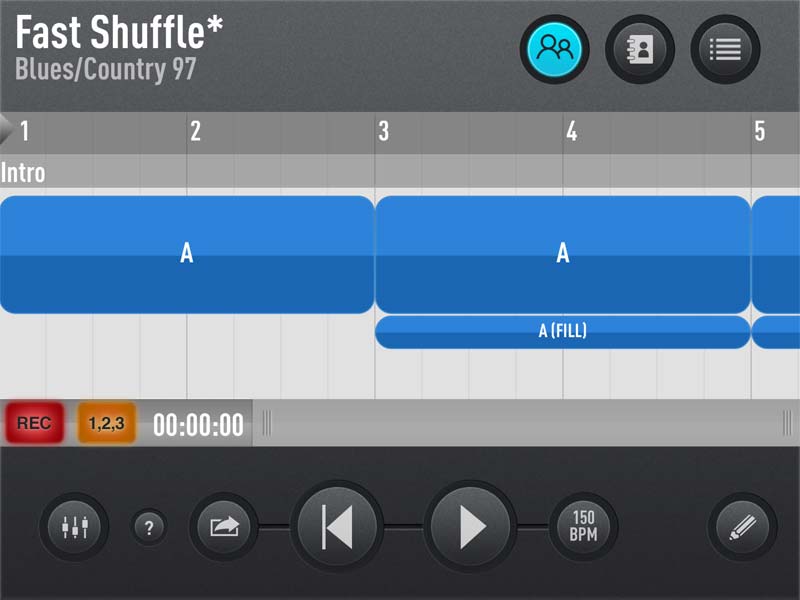
These apps are useful for creating automated backing tracks based on chords. Band-in-a-Box is one of the oldest in that genre, but it’s expensive and only works on PC and Mac. iReal Pro and especially SessionBand are cheaper and often more useful for designing short exercises on scales, etc.

Band-in-a-Box

Automatic chord and melody generation was introduced in 2014:

Impro-Visor

Impro-Visor (short for “Improvisation Advisor”) is a music notation program designed to help jazz musicians compose and hear solos similar to ones that might be improvised.

A free academic software project with auto-generated rhythm-section accompaniment.

iReal Pro

alt alt

SessionBand

SessionBand offers a great choice of styles recorded by professionals. It sounds more authentic than iReal, and the only negative point would be a limited choice of chord voicings.

Soundslice

The soundslice.com technology is used on many websites and offers state-of-the-art tools for combining audio, video, and sheet music:

alt alt

NomadPlay

NomadPlay is a French company specializing in play-along recordings of classical pieces. The website and app likely use the soundslice technology.

It’s It’s

alt alt

alt alt

Music Creation

BandLab

BandLab is a full-fledged DAW that can be used on iOS, Android, and PC/Mac in a browser:

alt alt

TextMusic

TextMusic is an app based on Jianpu numbered musical notation. All musical elements are written in plain text. Compositions or scale exercises can be quickly designed and exported to standard MIDI.

TextMusic iOS version

alt alt

alt alt

Others

SolfĂšge

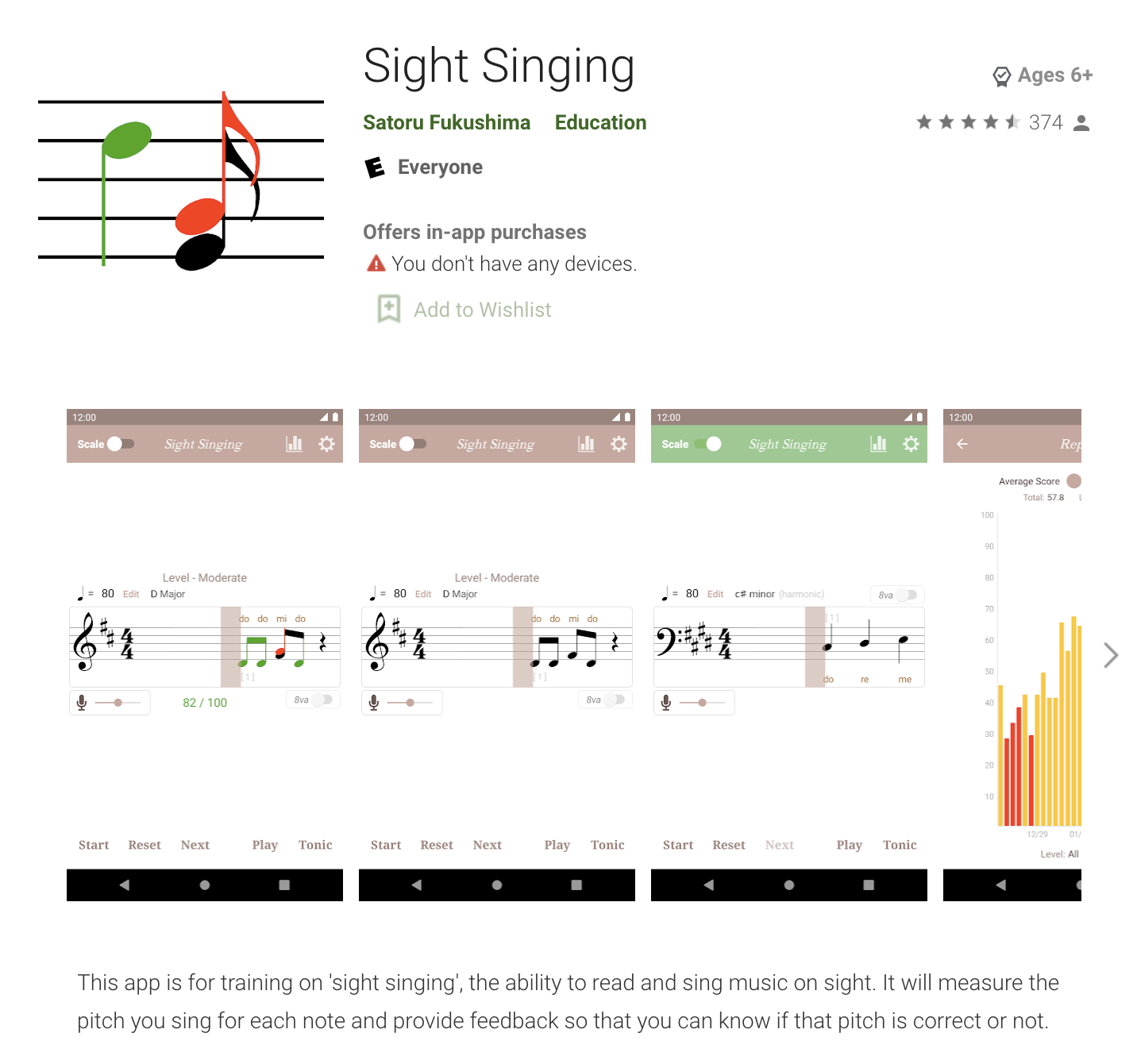
Sight Singing on iOS and Android records and evaluates your singing.

alt alt