Subsections of Randomness and Surprise in Teaching Improvisation
Introduction
Practice Time
No app, software, or method alone will make someone a seasoned improviser. Opening the next pages with such a bold statement might seem unscientific—which it is—but there is consensus1 among jazz players and teachers that there is no way around lifelong experiences of interacting with fellow musicians. There is also agreement on the value of, in jazz lingo, woodshedding or shedding—i.e., time spent secluded and focused on improving and developing new improvisation skills. Methods and tools are created to help make these sessions more interesting, stimulating, and “productive”.2
Interaction is the key word, because what most play-alongs and software tools3 still lack today is even minimal interactivity. Until artificial intelligence reaches a convincing level of real-time interaction with improvising human musicians, we are stuck with currently existing4 technologies.
The purpose of this research is to critically review one element that is becoming increasingly prominent in music creation apps but hasn’t yet found its way into music learning apps and software on a large scale: randomness. As I will try to demonstrate, it is one small step on the path toward real interaction. How to use and add chance, aleatoric, serendipitous, and surprise features in jazz and pop exercises is the focus of this research, linking it to my Master’s reflection report Kings and Queens of Serendip in Part I on this website. I will illustrate the technical side using adaptive audio technologies from video games to create exercises with random elements.
Electronic tools and helpers have taken a prominent role in music education. I have been involved in and have also created different software projects, listed on this website in the reflection report section (PercussionTutor, FlamencoTutor, Interakt). These apps and software projects all use random features, but, with the exception of Interakt, they only scratch the surface of their potential.
My sources include research on the element of surprise5 in a pedagogical setting as well as on tools (digital and otherwise), e.g., the use of flash cards. Furthermore, I used different jazz bass and improvisation methods to select the exercises that seemed best suited to integrating elements of surprise (cf. research section), with feedback from my bass teachers Matthias Akeo Nowak, John Goldsby, and Jo Didderen.
The 10 lessons in the research part all refer to specific exercises related to improvisation in a jazz and pop music context. When necessary, the different learning objectives and pedagogical and didactic actions are listed for beginner, intermediate, and more advanced students.
Berliner, P. F. (1994). Thinking in Jazz: The Infinite Art of Improvisation. Chicago Studies in Ethnomusicology. ↩︎
How exactly one might define productivity in improvising remains an open question. ↩︎
As a reference to the ironic “actually existing capitalism”, as e.g. in Fisher, M. (2009). Capitalist Realism: Is There No Alternative? Zero Books. ↩︎
E.g., Fortin, C., Gonzalez, E., & Carle, S. (2017). When the element of surprise fosters learning. Pédagogie Collégiale Vol. 30, N° 3, Spring 2017. ↩︎
Vision on Teaching
“Why did I want to become a music teacher and what is important in my relationship with students?”
I’ll answer this question from the perspective of someone who has been teaching for 12 years now after a career change. I divide my time between teaching, performing, and studying.
First, two closely related factors have driven me to start making music and to explore it. The first motivation could be considered somewhat selfish, but it is counterbalanced by my second driver. I only started playing and practicing late in my teens. Until then, I had always viewed music from the listener’s perspective, and although I felt very passionate about it, I thought its practice aspects were too similar to sports, for which I didn’t have a particular passion. I was completely wrong, of course; music and sports couldn’t be more different.
I have also always had a knack for languages, so the first key moment came when my bass teacher, during our very first lessons at age sixteen, encouraged me to listen to as many different genres as possible without being judgmental and without having a particular goal. So, the first motivation was to make connections, to learn music, and to play music that was presented to me as a language—more mysterious than spoken languages and remaining elusive at its core even today.
This passion for music as a language and cultural heritage is linked to my motivation to share that knowledge, and it ties in with my teaching activities. Of course, one of the main objectives is to transmit craftsmanship, but this doesn’t happen in a vacuum separate from cultural practices (listening to and performing music, the music industry, musicians’ roles, etc.). I also think that because I started late in my teens—which can be an impediment to reaching embodiment and mastery—I can relate more to students struggling with certain aspects of music-making or adults picking up an instrument later in life. These exchanges remain a source of inspiration and pleasure for me and, I hope, for my students.
“Why the choice of this subject for pedagogical research?”
Over the last 10 years, I have co-created several educational music apps with Jérôme Goldschmidt, Jonathan Levi, and Alex Greenwood. While they are all centered around rhythm and use different web and game audio technologies, the random element was always more of a side note. This research is an opportunity for me, on the one hand, to explore a teaching approach incorporating surprise elements and, on the other hand, to apply my experience with multimedia projects to create a proof of concept, as the following pages intend to demonstrate.
Research Question
Random elements in the context of teaching improvisation
In a sea of music methods, tools, software, apps, journals, and books on how to teach and practice improvisation, this research will focus on a single element and one main question:
Can an element of chance or randomness, and by extension the surprise it creates, be an interesting and productive factor in teaching improvisation?
Sub-questions
To go beyond a purely theoretical or literature-based approach, I created a series of interactive exercises intended as proof of concept. I hope this will allow readers, students, and other teachers to explore the different concepts. Each exercise will be presented first, and then specific pedagogical questions will be introduced.
The main sub-question could be phrased as:
Can typical jazz improvisation exercises benefit from elements of randomness?
As with any software project, specific technical questions, not directly relevant to research on teaching, will still need to be considered. I will list the most important ones: time necessary to create the exercises, time investment versus expected results, required technical expertise, and interactive features of a web-based app.
Methodology
Sources
The title of this research refers to randomness and surprise. My MA research opens by referencing an article1 on the essence of musical surprises. Musical surprises take on many forms: rhythmic, harmonic, melodic, timbral, and so on. Musical surprises are generally considered to fall under the category of perceptual surprises, characterized2 as frustrating prior expectations.
In the field of cognitive and behavioral science, research has been undertaken into the potential of surprise to stimulate learning:
“Music ranks among the greatest human pleasures. It consistently engages the reward system, and converging evidence implies it exploits predictions to do so. Both prediction confirmations and errors are essential for understanding one’s environment, and music offers many of each as it manipulates interacting patterns across multiple timescales. Learning models suggest that a balance of these outcomes … optimizes the reduction of uncertainty to rewarding and pleasurable effect.”3
The focus will be on these random elements and their potential to create surprises when introduced into typical jazz improvisation exercises and their impact on learning. One might view these music exercises as an elaborate form of flashcards (for an example of research on the potential of flashcards4 in increasing science vocabulary, see the reference). I also note the use of games in training musical skills. For example, rhythm exercises seem promising, as studies5 point to the importance of using games for rhythmic6 training. It is also worth noting that randomized tests are widely used in research on musical parameters such as pitch and rhythm recognition, as in pitch memory research.7
Every exercise also concludes with a short overview of:
the main learning objectives
teaching material used (mostly jazz bass and improvisation methods)
comments
Technical Aspects
Guidelines used for the exercise creation:
easy to use
good-sounding despite mostly using samples
multitrack8 enabled (mutes for different instruments)
short loading times
compatible with mobile and desktop devices
multiple browser support
concise in their scope
Here is an example of a flamenco multitrack playback (note: you should see “Channels Playing” and “CPU,” and use the playback and mute buttons):
Technical Details
For a detailed overview of the technical aspects of creating the exercises, please refer to the methodology section of my MA research. All the exercises were created with free tools from the field of music and audio design in computer games (cf. sections on adaptive audio and music in video games).
This methodology continues on the next pages with further sources and methods I used to compile the improvisation exercises, reference a final assignment9 on “How to Teach Improvisation,” and list different music apps.
Judge, J. (2018). The surprising thing about musical surprise. Analysis (Oxford), 78, 225–234. ↩︎
Huron, D. B. (2006). Sweet Anticipation: Music and the Psychology of Expectation. MIT Press. Judge, J. (2018, p. 226) ↩︎
Gold, B. P., Pearce, M. T., Mas-Herrero, E., Dagher, A., & Zatorre, R. J. (2019). Predictability and uncertainty in the pleasure of music: a reward for learning? Journal of Neuroscience, 39, 9397–9409. ↩︎
Aronin, S., & Haynes-Smith, H. (2013). Increasing Science Vocabulary Using PowerPoint Flash Cards. Science scope (Washington, D.C.), 37, 33–36. ↩︎
Bégel, V., Loreto, I. D., Seilles, A., & Bella, S. D. (2017). Music Games: Potential Application and Considerations for Rhythmic Training. Frontiers in Human Neuroscience, 11. https://doi.org/10.3389/fnhum.2017.00273↩︎
Duffy, S., & Pearce, M. (2018). What makes rhythms hard to perform? An investigation using Steve Reich’s Clapping Music. PLOS ONE, 13, 1–33. https://doi.org/10.1371/journal.pone.0205847↩︎
Schellenberg, E. G., & Trehub, S. E. (2003). Good pitch memory is widespread. Psychological Science, 14, 262–266. ↩︎
The multitrack feature in a web browser is interesting in itself, but the focus here is on randomness. ↩︎
From a music pedagogy course at the Luxembourg Conservatory in 2008 (Teacher: Martin Bertemes). ↩︎
Subsections of Methodology
Improvisation Scope
Teaching improvisation is too large a subject and not the focus of this research, so I’ll only refer to my collection of documents and methods on how to teach improvisation and post the synthesis documents here.
Methods I’ll reference include:
Sikora, F. (2017). Neue Jazz-Harmonielehre: verstehen, hören, spielen; von der Theorie zur Improvisation. Schott Music.
Crook, H. (2001). How to Improvise. Advance Music.
Siron, J. (2004). La partition intérieure : jazz, musiques improvisées. Outre Mesure.
Levine, M. (1995). The Jazz Theory Book. Sher Music.
Goldsby, J. (2002). The Jazz Bass Book: Technique and Tradition. Backbeat Books.
Goldsby, J. (2009). Bowing Techniques for the Improvising Bassist. Jamey Aebersold Jazz.
van de Geyn, H. (2007). Comprehensive Bass Method For Jazz Players (Book 1 & 2).
Brown, R., & others. (1999). Ray Brown’s Bass Method. Hal Leonard Corporation.
Sabin, R. (2020). Progressive Jazz Double Bass Repertoire.
Balse, H. (2005). L’évolution du rôle de la contrebasse dans le jazz jusqu’en 1960. De Jimmy Blanton à Scott LaFaro. Université Paris 4 - La Sorbonne.
Sher, C. (1979). The improviser’s bass method: For electric and acoustic bass. Sher Music.
Sher, C., & Johnson, M. (1993). Concepts For Bass Soloing. Sher Music Company.
Galper, H. (2005). Forward Motion. Sher Music.
Ligon, B. (1996). Connecting chords with linear harmony. Hal Leonard Corporation.
Levine, M. (1989). The Jazz Piano Book. Sher Music.
Pratt, G., Henson, M., & Cargill, S. (1998). Aural awareness: Principles and practice. Oxford University Press. (relevant topics for improvisation)
Overview
The following is a plan for teaching improvisation that I designed for a final assignment in Martine Bertemes’ pedagogy course at the Luxembourg Conservatory:
Parameters Mindmap
I use this mindmap, which summarizes several jazz methods, as a study guide for students:
Compositional and Improvisational Techniques in Jazz
In this selection of music apps that I use regularly, only a few offer random functions. Those are most often found in creative rhythm apps and not in the ones designed for practicing. Some melody and harmony training music apps rely on randomly generated exercises to train pitch or chord hearing (e.g., EarMaster).
Ear Training Apps
EarMaster
It has random flashcard-like functions for training intervals, scales, chords, etc.
The author, Avi Bortnick, calls it a “self-muting compound time metronome.” It is one of the few apps with a random setting slider to mute certain notes.
“Time Guru is the only metronome with the ability to mute its sound at random, in patterns, or both, so that you can assess whether you tend to rush or drag. Time Guru periodically leaves you on your own so that you strengthen your own internal sense of time, rather than relying on the constant, rigid, external time keeping of a metronome. Sometimes the training wheels should come off! It is the ultimate tool for becoming a rock-steady time guru.” avibortnick.com/time-guru/
Tempo Advance
Tempo Advance by Frozen Ape is a classic with many options that don’t get in the way:
Elastic Drums is a drum-machine-like app with extensive sound-tweaking capabilities. Some random play functions have been added:
PercussionTutor
www.percussiontutor.com, my own creation: a library and practice app with rhythms from Cuba, Puerto Rico, the Dominican Republic, Peru, Brazil, and West Africa, expanding to other cultures (e.g., Flamenco). The Batá section contains a random dialogue between the iyá and itótele drums.
Apple
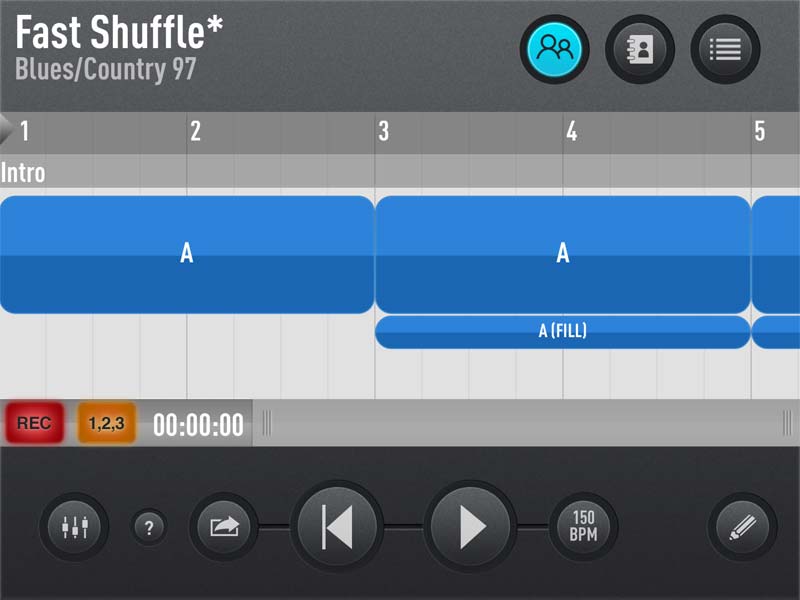
GarageBand, etc., but these tend to be distracting if a timekeeper is all that’s needed.
Play Along
These apps are useful for creating automated backing tracks based on chords. Band-in-a-Box is one of the oldest in that genre, but it’s expensive and only works on PC and Mac. iReal Pro and especially SessionBand are cheaper and often more useful for designing short exercises on scales, etc.
Band-in-a-Box
Automatic chord and melody generation was introduced in 2014:
Impro-Visor (short for “Improvisation Advisor”) is a music notation program designed to help jazz musicians compose and hear solos similar to ones that might be improvised.
A free academic software project with auto-generated rhythm-section accompaniment.
SessionBand offers a great choice of styles recorded by professionals. It sounds more authentic than iReal, and the only negative point would be a limited choice of chord voicings.
Soundslice
The soundslice.com technology is used on many websites and offers state-of-the-art tools for combining audio, video, and sheet music:
NomadPlay
NomadPlay is a French company specializing in play-along recordings of classical pieces. The website and app likely use the soundslice technology.
Music Creation
BandLab
BandLab is a full-fledged DAW that can be used on iOS, Android, and PC/Mac in a browser:
TextMusic
TextMusic is an app based on Jianpu numbered musical notation. All musical elements are written in plain text. Compositions or scale exercises can be quickly designed and exported to standard MIDI.
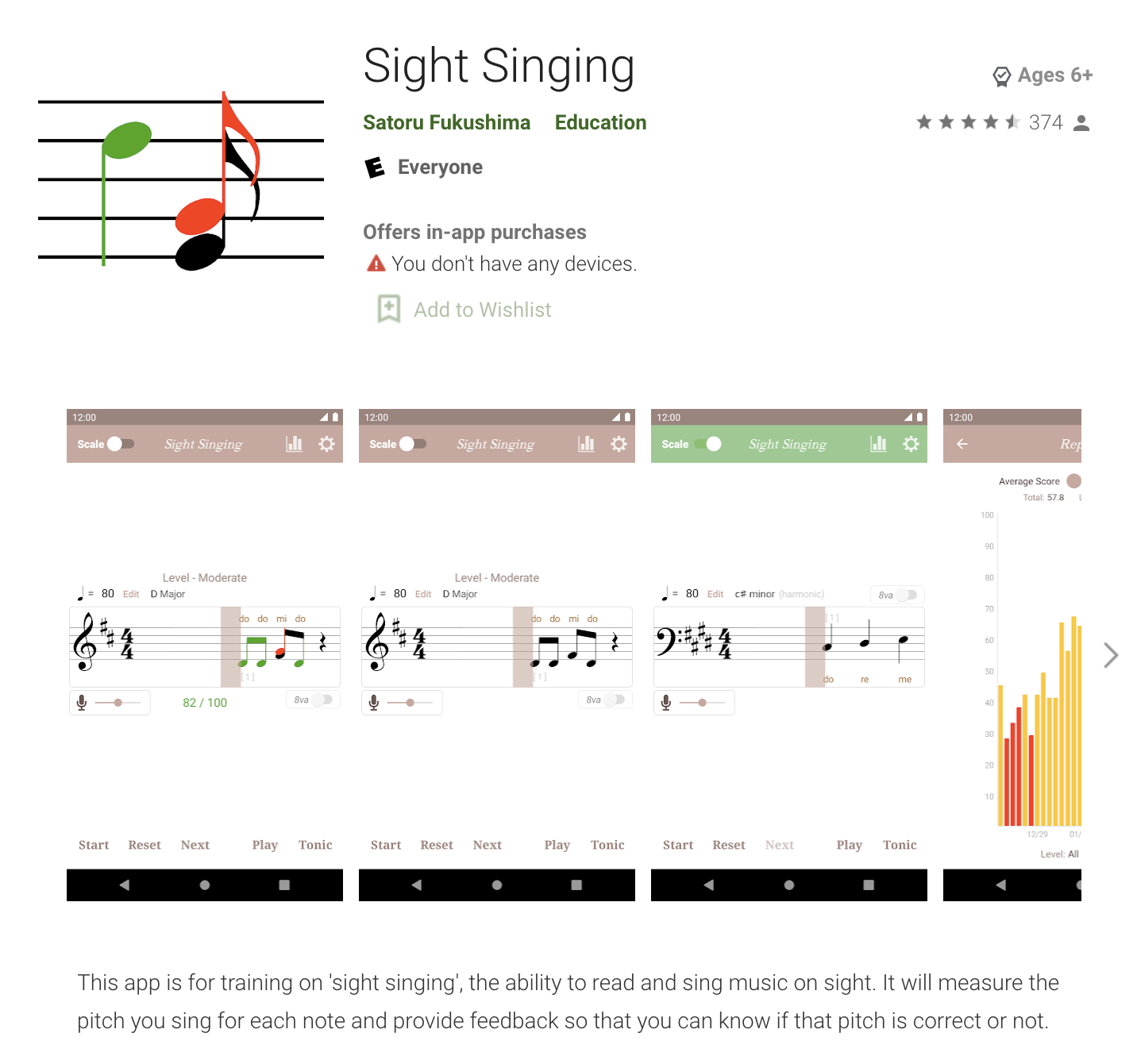
Sight Singing on iOS and Android records and evaluates your singing.
Research
Subsections of Research
Scales and Arpeggios
This part is dedicated to aspects of scale practice and usage in improvisation.
Subsections of Melodic Material
Major and Minor Scales
Major and Minor Scale Practice and Its Shortcomings
The adapted exercise with random chord changes (cf. end of section) is an exercise for beginners that will help them to:
learn minor and major scales
internalize the weight and direction of each scale
understand and hear the relationship between relative major and minor
experience the weight of the lowest bass note, which changes the perceived harmony (minor or major)
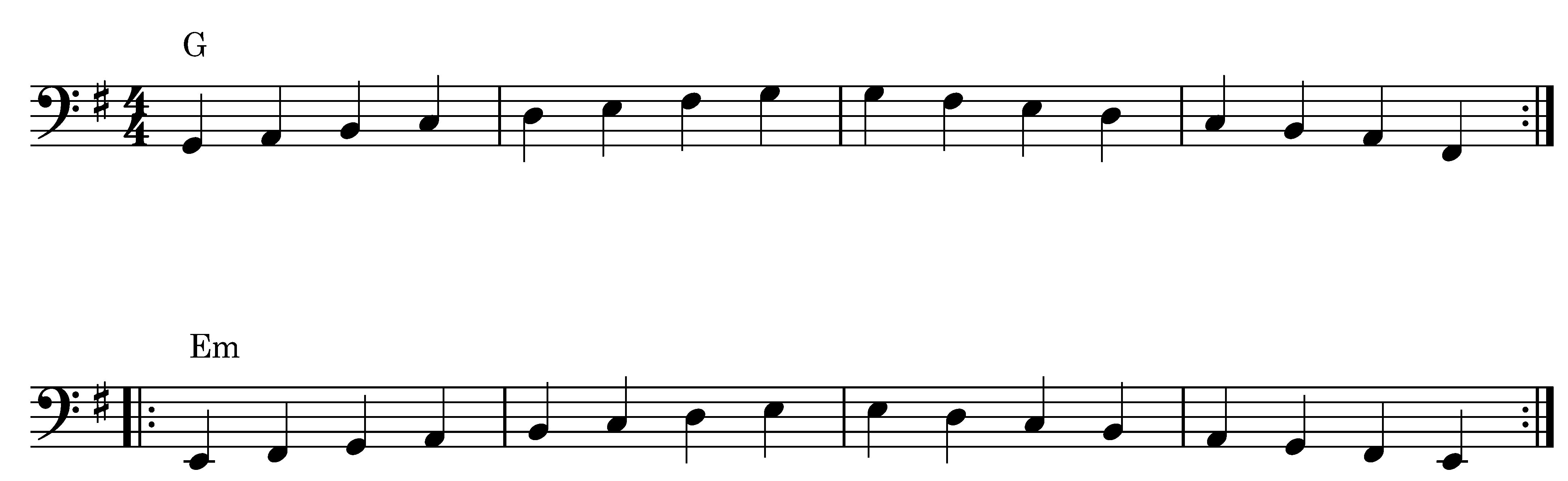
The major scale and its relative natural minor scale are a minor third apart and share the same notes. A typical scale practice exercise uses a G major or an E natural minor scale in one position up to the octave, ascending and descending.
In this situation, although the repeated G in bar 3 is quite common, it is not a very musical way to practice scales over a backing track because chord tones in the second half will not fall on strong beats. In the last bar, the F# is played before going back to G, which smooths out the line. For the E minor scale, the final E is doubled, which breaks the flow.
Furthermore, although the same notes are to be played in the two scales, no connection is revealed to the student. The following exercise is an adapted version where the flow is maintained throughout and the two shortcomings of the base exercise are addressed:
chord tones now fall on strong beats in the descending scale
the two scales are linked visually and in terms of practice
the exercise becomes musically circular
Here is a seven-bar circular version of the same exercise. The harmony starts to blur, with the lowest note influencing the perception of minor/major. This exercise could also start on E:
The accompaniment track with guitar and piano either plays a G chord at a slow tempo (80 bpm):
or an Em7(add 11) voicing:
Learning Objectives with Randomized Chords
This is the randomized exercise. Every two bars, either an Em7(add 11) or a G will be played on guitar and piano. The main objective for a beginner will be to use the correct fingering and aim for legato playing at a slow tempo. A more advanced student can focus attention on the sound and emotional effect produced by randomly changing chords.
Continuous Scale Exercise
Altered and Octatonic Scale over iiø7-V7-i and ii-V7-I
Learning Objectives for the Continuous Scale Exercise
Several standard jazz improvisation methods1 list the continuous scale exercise as one of the main exercises to master. It can be adapted for beginners and more advanced students. The example above only uses two chord progressions with an altered chord resolution going to a minor or major chord. The preceding ii will give away the continuation of the exercise and could be left out.
Randomized Chord Progressions
When the two progressions are randomized, the student (intermediate to advanced in this case, especially if played in thumb position) has to make minor adjustments in bar three when resolving. This helps students rely on their ears to anticipate the resolution and trains them to differentiate altered chords and their respective resolutions.
This exercise can easily be extended, and the evaluation and learning points can be gradually integrated and checked by adding more chord progressions or more difficult ones. The student can use the same exercise to train at home and during class.
E.g., Levine, M. (1995). The Jazz Theory Book. Sher Music. ↩︎
Pentatonic Exercise
Strength of the Pentatonic Scale
Pentatonic scales are used extensively in many different musical styles and have been widely adopted in jazz. Pentatonic scales have a strong independent sound and “it is very easy to perceive them as bitonal elements on top of the harmony” (van de Geyn, 2011, p. 8).
In an instructional video from the 1980s, John Scofield1 discusses his approach to pentatonic scales. The following table summarizes the available inside-sounding options2 according to chord type:
Chord Type
HVG
HVG
HVG
Scofield
CMaj7
A-
E-
B-
C, A-, D, Ddom penta, B-
C-7
G-
C-
C-, G-, D-
C-Maj7
D-
C7(9 13)
A-
C, Cdom, Ddom, G-
C7alt
Eb-
Eb-
C7ø7
F-
Eb-
Ab dom
Single Pentatonic Major Scale Over Changing Chords
The following is an exercise I designed for intermediate-level students that helps them perform pentatonic major (and their relative minor) scales all over the neck on all four strings in different positions. It’s built around the chords of “Sunny”3, a tune with a melody based solely on minor pentatonic notes but with changing chords.
In the following version in E minor, adhering strictly to the E minor/G major pentatonic scale will create tension on certain chords, but overall strong melodic motion will result. In “The Serious Jazz Book II,” B. Finnerty4 lists similar exercises with arpeggios or different cells.
Here is the exercise with piano and bass:
Here is the exercise as I uploaded it to the MuseScore website, with advanced MIDI playback (but no chord playback):
Scofield, J. (1983). John Scofield on improvisation. ↩︎
Scofield also refers to a “dominant pentatonic scale”: C D E G Bb. ↩︎
Finnerty, B. (2008). The Serious Jazz Book II. Sher Music. Cf. “Part 2 - An Integral Part Of Seven Diatonic Scales And Their Modes”. ↩︎
Groove
Groove, Rhythm, Time Feel
This part is dedicated to aspects of rhythmic accuracy, groove, and performing complex rhythms. Time is most likely the key element to master for every jazz and pop musician, but it is also one of the most elusive parameters. Pianist Fred Hersch, referring to a performance, puts it this way:
“There should be ten, fifteen different kinds of time. There’s a kind of time that has an edge on it for a while and then lays back for a while. Sometimes it rolls over the bar, and sometimes it sits more on the beats. That’s what makes it interesting. you can set a metronome here and, by playing with an edge of playing behind it or right at the center, you can get all kinds of different feelings. That’s what makes it come alive. People are human, and rhythmic energy has an ebb and flow.”1
Most instrument methods or books on jazz improvisation contain specific chapters on rhythm, but very few are entirely dedicated to purely rhythmic aspects, with the exceptions of, for example, a book2 by drummer Bob Moses or a method3 by drummer Billy Martin.
A few words of caution on working with metronomes and machines appear in the following video4 by Richie Beirach on developing a better sense of time:
“Listen to great examples … check Out Speak no Evil, listen to Elvin Jones, Herbie, Freddie, Wayne, Ron Carter”
“Forget about the metronome”
“Metronomes are suicide for the Jazz musicians”
“Metronomes are good for kids because when you are practicing you are lonely and scared and it helps to feel not so lonely”
“Perfect time doesn’t help you with your jazz rhythm.”
“Is a click track great for pop music? Yeah, it keeps everybody together. Pop music can be creative, but it is not improvised; it is a whole different genre. I believe in the click track too.”
Berliner, P.F. (1994). Thinking in Jazz: The Infinite Art of Improvisation. Chicago Studies in Ethnomusicology. ↩︎
Moses, B. (1984). Drum Wisdom. Modern Drummer Publications (republished in 2022 as a Kindle edition). ↩︎
Martin, B. (2006). Riddim: Claves of African Origin (D. Thress, Ed.). Alfred Music. ↩︎
Beirach, R. (2021). Richie Beirach on developing a better sense of time. https://vimeo.com/539936515/5c86756b12. (These wise words might serve as a natural antidote, but it is still advisable to get your shots.) ↩︎
Subsections of Groove
Time Feel
Breaks and Drum Fills
In pop music, drum fills are often played at specific points in the cycle—for example, every 4 or 8 bars—and are often improvised. The following exercise will help you keep time during the fill. The first example uses simple in-time fills with no rests. The learning objectives in this case can be loosely defined—for example, use an easy, well-mastered exercise to play along and keep time.
Exercise 01: Fills
Note that the 3-bar groove consists of 3 different drum groove alternatives, and the 5 fills are played randomly every 4 bars. The groove is inspired by “Kissing My Love”1 by Bill Withers.
Exercise 02: 2-Beat Rests
Exercise 2 is more challenging, leaving two beats of rest in bar 4.
Exercise 03: Start With Rest During Break
Exercise 3 reverses the concept of ex. 2 and starts random breaks with two beats of rest.
Exercise 04: Full Bar of Rest
Exercise 4 stops right before beat 4 of bar 3 and leaves a full bar of rest. This exercise can now be extended to two or even three bars of rest.
Random Mix of Rests and Fills With Count-In
The next iteration would be very difficult to recreate in some DAWs, even Ableton (especially if non-metered audio files were used). It leverages the adaptive audio features by creating a mix of all preceding exercises. Now, for every cycle of four bars, the following happens at random:
one of 4 drum patterns is picked
one of 5 fills is selected
one of 5 exercises is selected
Behind the Scenes
On the technical side, the same short drum loops are used in all the preceding examples and then recombined, which multiplies the number of possibilities from simple base material. Please refer to the chapter from the main thesis for further technical details and the problems with creating perfect loops and testing all possibilities.
The Time Guru metronome (see methodology section) uses a random slider with a percentage setting to select the probability of drum hits being played. A gradual fade option is added to this “random mute slider”:
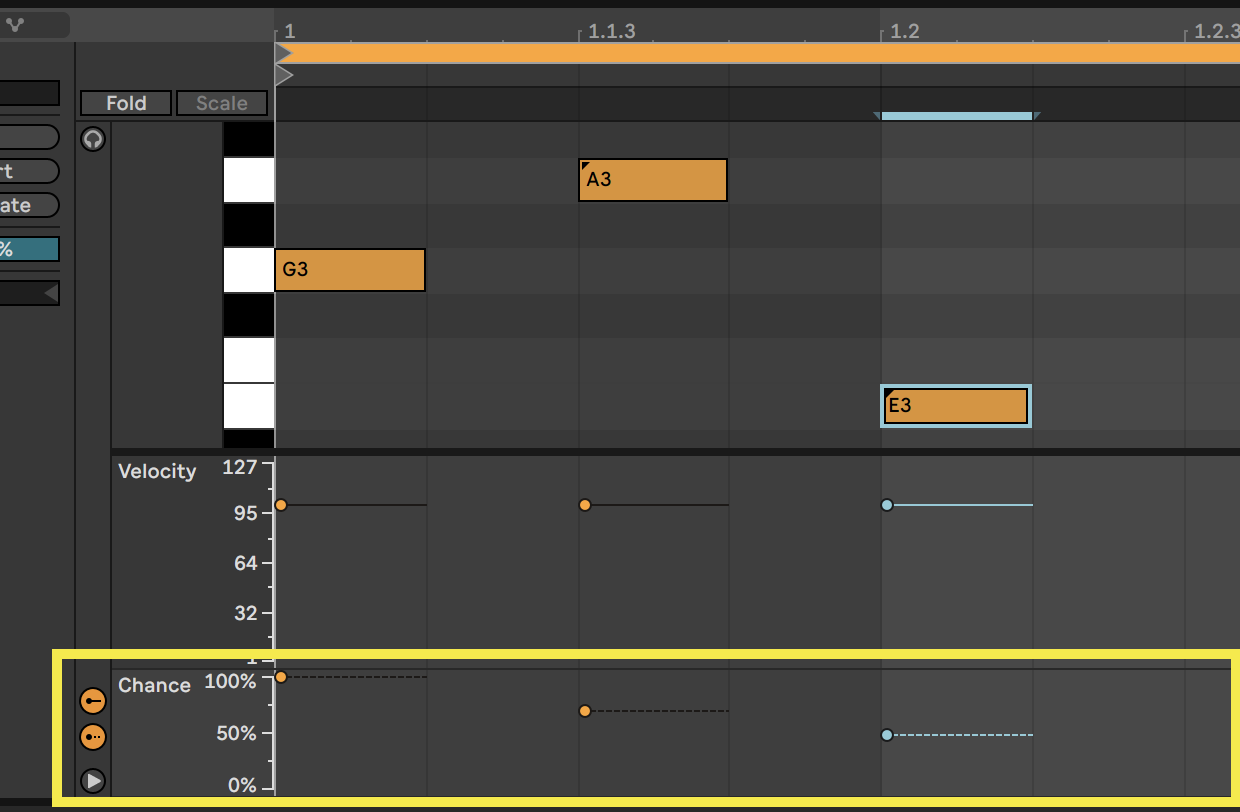
Many DAWs and plugins offer functions to set playback probabilities, although as a standard feature in some DAWs, this is a recent1 development.
Drum Kit Mutes
The next exercise applies this idea to a drum kit by randomly fading out certain parts of the drum kit, limited for the sake of this example to bass drum, snare, and hi-hat. Although fades happen randomly, the exercise was constructed so that there are no long blanks with every element of the kit being muted. This silence setting is one key element in finding the right difficulty level for this exercise.
The objectives can be varied—for example, as in the previous exercise, use a simple exercise and play along without losing time, or for more advanced players, increase the fade times and play more advanced improvisations or exercises.
A chance setting for notes was only introduced in Ableton Live 11 in February 2021. ↩︎
Rhythmical Displacements
Melodic Displacements
The following example uses 4 rhythmic displacements (eighth note, quarter note, and sixteenth note). These rhythmic devices are used extensively in composition1 and improvisation. This is a basic example, though only the eighth-note and quarter-note displacements might be appropriate for beginners.
Randomized Displacement With Different Exercise Options
Options a, b, c, and d are played randomly, with a 15% chance setting for option d, which can be considered the most difficult performance-wise.
Also note that:
the drum groove is 4 bars long and randomly plays 3 different variations
there are 2 possible drum fills, one with a 1-bar drum silence
the guitar part is 8 bars long with different rhythmic variations on E7#9.
This is a good example of the potential for spontaneous variation by using short, similar loops of different lengths.
Based on this simple example, many variations can be created. By muting the drums, the guitar, or both, the playback becomes a time-keeping exercise. The quantize setting can be randomized, and more advanced subdivisions become imaginable, such as transformations2 into other beat subdivisions (triplets, quintuplets, septuplets) and their respective displacements.
Cf. rhythmical sangatis, p. 61, in Reina, R. (2017). Applying Karnatic Rhythmical Techniques to Western Music. Routledge. ↩︎
Swing Ratios
Swing ratios are commonly used in music notation programs to emulate swing feel. Expressed as a percentage, the ratio refers1 to consecutive eighth (or sixteenth) notes performed as long-short patterns. Microtiming2 studies have shown that these ratios vary widely depending on style, tempo, musicians’ affinities, and cultural background.
In a fascinating article3 on the impact hip-hop producer J Dilla had on live drum kit performance and pedagogy, Daniel Stadnicki analyzes “how the so-called ‘Dilla-feel’ is emulated by drummers and rhythm section players through a range of informal learning strategies and extended techniques, which include practices of online teaching and learning.”
J Dilla used4 the Akai MPC music workstation, which offers sampling and sequencing capabilities. Swing ratios can be set as a percentage. In DAWs, different names are used—for example, grooves in Ableton, groove quantize presets in Cubase, or groove templates in Logic. Another way to express this swing ratio is by using tuplet notation. This approach certainly doesn’t do justice to the different shades of microtiming, but it has the merit of offering a clear approach to these types of grooves.
The cowbell from the Afro-Peruvian Festejo rhythm is an example of an original swing feel between binary and ternary time:
Festejo with cajita, quijada, congas, bongo, and cajon:
Feel the Swing
I took inspiration for the next exercise from a 16-year-old beginner student who, while working on shuffle songs, asked me why the groove of some hip-hop tunes felt5 so different from, for example, blues shuffle songs. In the next example, the drum groove over the first 2 bars is straight, which corresponds to a 50% swing ratio or no swing at all; the two notes on the hi-hat have the same length. The swing feel on the hi-hat in bars 4 and 5 equals a 66.6% swing ratio, or a perfect triplet division, with the first note taking up 2/3 of the beat division and the second 1/3. A 60% swing ratio would correspond to 3 and 2 quintuplets (bars 5 and 6). A septuplet division (5 and 3 septuplets) yields approximately a 57% swing ratio.
Guess the Ratio
When randomizing this example with two-bar fragments, different exercises are conceivable for beginner to intermediate students:
try to identify whether a change happens (a two-bar sequence might be played twice or more; 25% chance setting)
identify the ratio
play along with only quarter notes
try to emulate the feeling by adapting your bass line to the drum groove
Friberg, A., & Sundström, A. (2002). Swing Ratios and Ensemble Timing in Jazz Performance: Evidence for a Common Rhythmic Pattern. Music Perception, 19, 333–349. ↩︎
Collier, G. L., & Collier, J. L. (1996). Microrhythms in jazz: A Review of Papers. Annual Review of Jazz Studies, 8, 463–483. ↩︎
Stadnicki, D. A. (2017). Play like Jay: Pedagogies of drum kit performance after J Dilla. Journal of Popular Music Education, 1, 253–280. ↩︎
There is a wide range of techniques and approaches to intonation exercises on the double bass. Some rely on play-along software, reference tones, or backing tracks.
Relying on a drone-like instrument or synthesizer sound can help you feel the distance between notes. In Karnatic and Hindustani music, a drone—tambura (or tanpura in North India)—is used to lay the groundwork1 for the melodic instruments:
Many different tunings exist, and the one using the root note, the fifth, and the octave is widely used.
Here is an example of a drone on D (with 440 Hz reference tuning). The fifth A is tuned to a pure 3:2 interval ratio.
Randomized change of root note and fifth with a drone
The following exercise randomly changes the root note, either D or Eb, with added perfect fifths and octaves, and also randomizes when this change occurs.
Beginner students can make use of this exercise by:
focusing only on the root change from D to Eb
playing D and Eb in all ranges across the neck
using bowing or pizzicato
adding a fifth or an octave
experimenting with different fingerings or same-finger shifts
Typical Turnarounds on Rhythm Changes or Blues Form
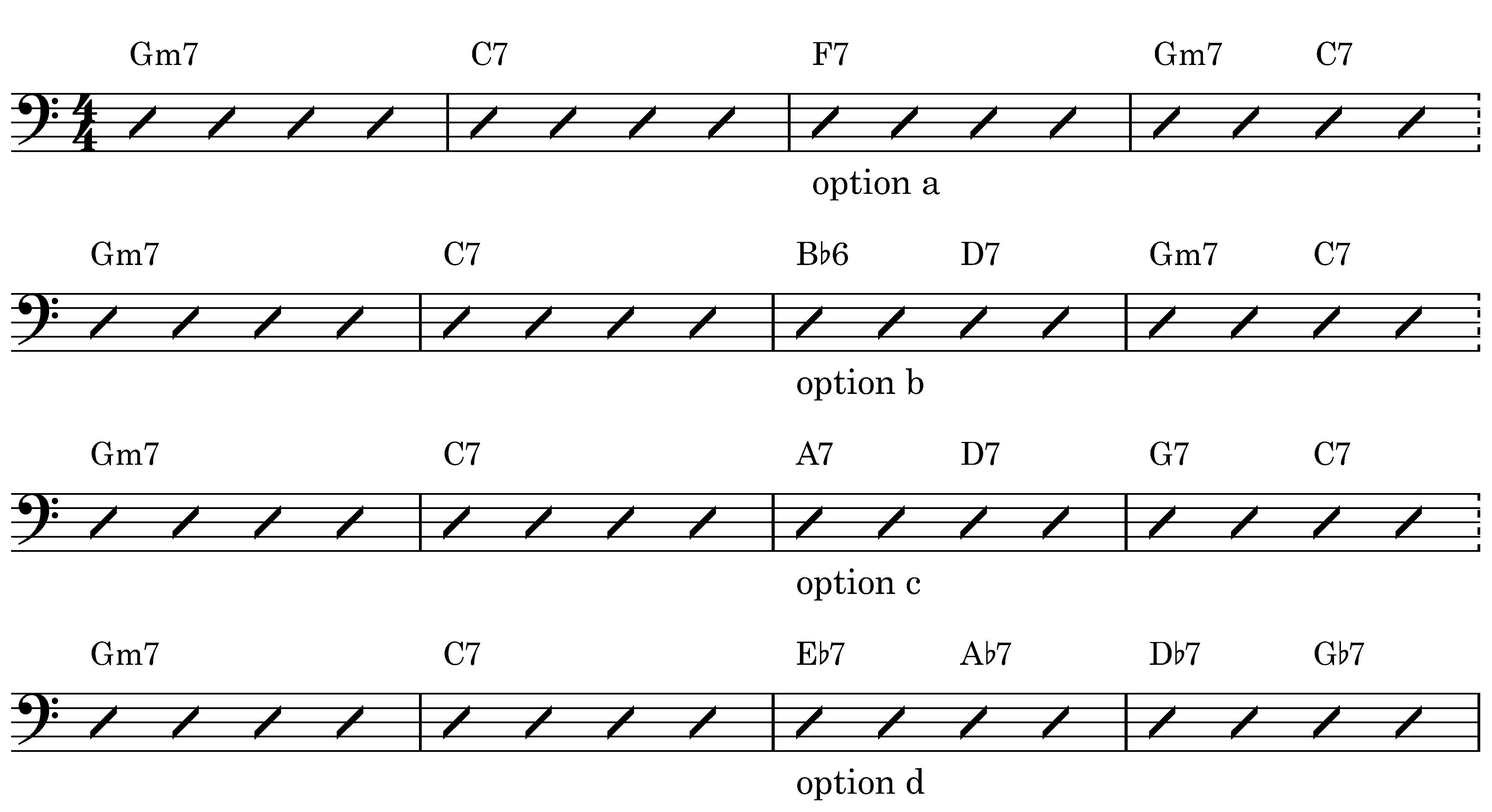
Here are four patterns (a, b, c, d) used in bars 9–12 of a typical F jazz blues:
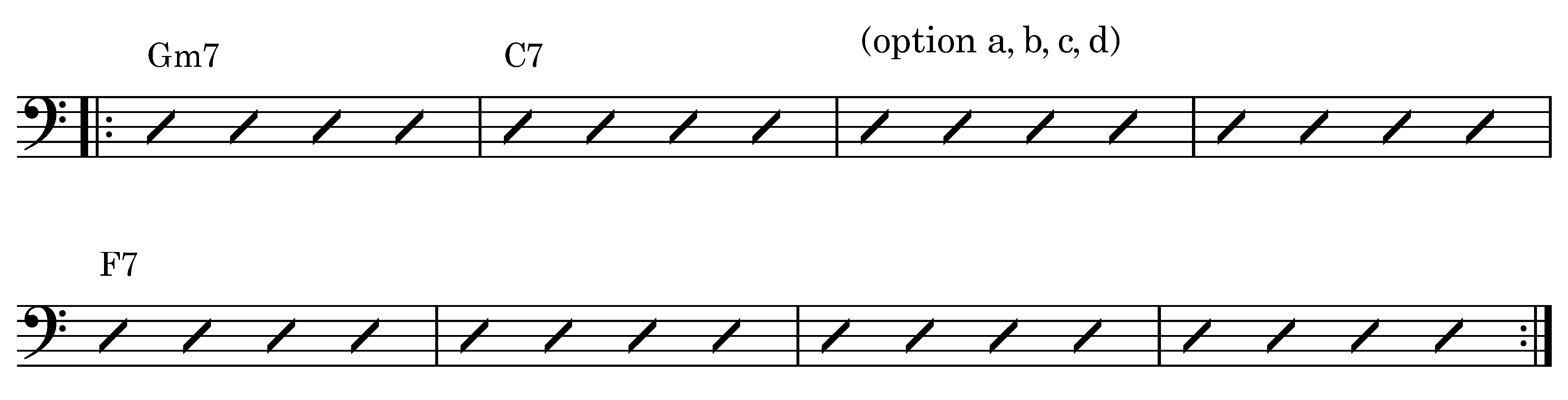
Randomized Turnaround Options
The following playback will select one of the four options by chance. The 8-bar piano part is underlaid with a 6-bar drum groove grouped in sections of 2 bars each, with loops randomly picked from 4 options. This creates additional layers of variation.
Objectives
Here again, the basic principle is an audio flashcard. Students of different levels can focus on specific things:
recognize the changes as quickly as possible
sing along
learn one option at a time
master all the changes and force yourself to pick one in advance and play it even when recognizing another option. This is an interesting exercise and will help students think less rigidly about harmonic forms—for example, a student plays option d while hearing c, which functions as a subV.
Rhythm Changes
Chord Change Variations Over a Rhythm Changes Form in the B Section
Many jazz tunes use the rhythm changes harmonic progression as a base template. The B section is a playground for different1 reharmonizations.
Here is an audio example of the three options, preceded by four bars over Bb6:
Randomized Versions
This is a variation of the blues turnaround memorization exercise. Each option (a, b, or c) is played twice. This allows the student to hear the progression once and then repeat it, or at a later stage, play each option two times.
Thanks to WDR bass player and teacher John Goldsby for option c. ↩︎
Conclusion
The preceding pages offer only a glimpse into the potential of using random elements in teaching improvisation and bridging the gap between human interaction and playing with a machine. Each of the topics (rhythm, harmony, etc.) could be investigated separately and would require focus groups and extensive testing.
The rhythm exercises, with random elements very similar to those found in video games (which use random events at the core of gameplay), seem the most promising with regard to recent research.1 Other studies point to the potential of using games for rhythmic training.2
I created some of these exercises for my own practice during the two years of MA study and devised other exercises for beginning and intermediate students. While the novelty effect was real and the ease of use and learning objectives were well understood, the main weak point is the amount of time required to create each exercise. The creation steps are as follows, not counting the initial development required to arrive at a working system:
design of an exercise
chord and melody creation in music editing software (Dorico)
DAW editing (Pro Tools and Ableton in this case)
DAW mixing
export to FMOD (game audio engine)
web page design and coding
This amount of work would increase when recording real musicians. The input/output ratio needs to be further critically investigated. The system is also well suited to a collaborative and remote working approach.
Inspiration for Teachers
A positive and very rewarding aspect of this research was the challenge and enjoyment of creating exercises that use these random elements. Reviewing and inventing typical jazz improvisation exercises—from simple scale and arpeggio practice to more complex upper structure concepts—was rewarding and shed new light on exercises that might often seem repetitive or even stale. Play-along exercises could be made more engaging even through minimal random variations.
Bégel, V., Loreto, I. D., Seilles, A., & Bella, S. D. (2017). Music Games: Potential Application and Considerations for Rhythmic Training. Frontiers in Human Neuroscience, 11. https://doi.org/10.3389/fnhum.2017.00273↩︎
Duffy, S., & Pearce, M. (2018). What makes rhythms hard to perform? An investigation using Steve Reich’s Clapping Music. PLOS ONE, 13, 1–33. https://doi.org/10.1371/journal.pone.0205847↩︎
Bibliography
Aronin, S. and Haynes-Smith, H. (2013), Increasing Science Vocabulary Using PowerPoint Flash Cards, Science scope (Washington, D.C.) 37(3), 33–36.
Bégel, V., Loreto, I. D., Seilles, A. and Bella, S. D. (2017), Music Games: Potential Application and Considerations for Rhythmic Training, Frontiers in Human Neuroscience 11.
Beirach, R. (2021), Richie Beirach on developing a better sense of time.
Berliner, P. F. (1994), Thinking in Jazz: The Infinite Art of Improvisation, Chicago Studies in Ethnomusicology.
Brown, R. and others (1999), Ray Brown’s Bass Method, Hal Leonard Corporation.
Cheung, V. K., Harrison, P. M., Meyer, L., Pearce, M. T., Haynes, J.-D. and Koelsch, S. (2019), Uncertainty and surprise jointly predict musical pleasure and amygdala, hippocampus, and auditory cortex activity, Current Biology 29(23), 4084–4092.
Crook, H. (2001), How to Improvise, Advance Music.
Finnerty, B. (2008), The Serious Jazz Book II, Sher Music.
Fisher, M. (2009), Capitalist Realism: Is There No Alternative?, Zero Books.
Fortin, C., Gonzalez, E. and Carle, S. (2017), When the element of surprise fosters learning, Pédagogie Collégiale vol. 30, n° 3, Spring 2017.
Friberg, A. and Sundström, A. (2002), Swing Ratios and Ensemble Timing in Jazz Performance: Evidence for a Common Rhythmic Pattern, Music Perception 19, 333-349.
Galper, H. (2005), Forward Motion, Sher Music.
van de Geyn, H. (2007), Comprehensive Bass Method For Jazz Players (Book 1).
van de Geyn, H. (2007), Comprehensive Bass Method For Jazz Players (Book 2).
van de Geyn, H. (2011), 12 Jazz Etudes.
Gold, B. P., Pearce, M. T., Mas-Herrero, E., Dagher, A. and Zatorre, R. J. (2019), Predictability and uncertainty in the pleasure of music: a reward for learning?, Journal of Neuroscience 39(47), 9397–9409.
Goldsby, J. (2002), The Jazz Bass Book: Technique and Tradition, Backbeat Books.
de Graaf, D. (2017), Beyond Borders. Broadening the Artistic Palette of (Composing) Improvisers in Jazz.
Huron, D. B. (2006), Sweet Anticipation: Music and the Psychology of Expectation, MIT Press, Cambridge, Mass.
Judge, J. (2018), The surprising thing about musical surprise, Analysis (Oxford) 78(2), 225–234.
Levine, M. (1989), The Jazz Piano Book, Sher Music.
Levine, M. (1995), The Jazz Theory Book, Sher Music.
Ligon, B. (1996), Connecting chords with linear harmony, Hal Leonard Corporation.
Margulis, E. H. (2007), Surprise and listening ahead: Analytic engagements with musical tendencies, Music Theory Spectrum 29(2), 197–217.
Martin, B. (2006), Riddim: Claves of African Origin, D. Thress (ed.), Alfred Music.
Moses, B. (1984), Drum Wisdom, Modern Drummer Publications.
Sabin, R. (2020), Progressive Jazz Double Bass Repertoire.